

The Buddhism & AI Conference was held at Rangjung Yeshe Gomde in the beautiful foothills of the Austrian Alps in July. Alongside a handful of partner organizations, we helped coordinate the 4-day gathering to explore Buddhist perspectives on AI through a wide array of topics including, consciousness, embodiment, attention, education, agency, and alignment. Featuring multidisciplinary panels and group discussions, the conference also served as a retreat, with each day being bracketed by meditation sessions and morning teachings by Chokyi Nyima Rinpoche.
I’ll share the essence of the content sessions and some of my bigger takeaways from the conference woven through my personal reflections in hopes of relating some of the key dynamics of this emerging niche of Buddhism & AI.

Photo: Harald Weichhart
The Setting: Nature, Community, and Dharma
There is a beautiful garden in front of the retreat center built and maintained by the all-volunteer staff that live and work there. The central water feature includes a mix of lotuses and water lilies. Wonderful examples of convergent evolution; they are actually two distantly diverged species that now occupy the same environmental niche. Traditionally, the lotus represents pristine awakening emerging from the muck of conditional existence, but I suppose the water lily could fulfill the metaphor just as well. I found this a very evocative symbolism for a conference on AI where functionalism, the philosophy of mind that defines things by their purpose rather than their substance, reigns supreme.
I continue to find the highest value in conferences like this is being together in person with a group of kindred spirits. Those of us interested in the small niche of Buddhism and AI seem to swim in the same mindstream or perhaps share an attractor space of concepts. We’ve read similar things, have sometimes eerily familiar ideas, and share many underlying values and concerns. Of course we have meaningful differences as well, but it all leads to great mealtime conversations and a sense of belonging and community.
Chokyi Nyima Rinpoche’s morning talks were composed of traditional dharma teachings peppered with some hilarious anecdotes about modern life, psychedelics and AI. I think his teachings could be paraphrased by just two invitations: cultivate an awakened heart (bodhicitta), and study and practice ardently to realize the nature of mind—deep intention matched with clear purpose. For me, the “elephant” in the room was whether AI can meaningfully support either of those.
Session 1: Consciousness & Worldviews
John Dunne opened the panel by noting how differing views of consciousness shape engagement with AI. Lars Sandved-Smith made a pragmatic case for computational functionalism (though his actual views are more complex), sidestepping metaphysical certainty in favor of useful models. Francesco Tormen compared transhumanism’s utilitarian ethics to Mahayana Buddhism while flagging their divergent accounts of suffering’s root cause. Murray Shanahan used Wittgenstein and Nāgārjuna to challenge the dualistic assumptions baked into AI-consciousness debates, and Gabor Karsai set Varela’s enactivism and Whitehead’s process philosophy against computationalism, stressing that cognition is embodied, relational, and affectively toned. John Dunne warned that LLMs risk mistaking the map (conceptual systems) for the territory (lived experience), and Peter Hershock tied the threads together with a call for epistemic humility and a relational, karma-informed approach to AI centered on ethical concerns about how AI is shaping human consciousness.
The intersection of Buddhism and AI has an undeniable gravitational pull to matters of consciousness. In order to bound this perennially slippery topic we adopted the premise that our beliefs about the consciousness of AI systems is largely downstream of our tacit views of human minds and reality more broadly. For example, computational functionalism and transhumanism, prominent views informing AI development, tend toward suppositions of AI consciousness and substrate independence, whereas enactivism, a critical bridge between Buddhist philosophy and Western cognitive science that views the mind as an embodied and enacted process, tends to oppose AI consciousness. Depending on which Buddhist doctrine you emphasize, arguments can be made for either side. This session set a puzzling stage for the conference, making apparent the fact that, without a shared definition of consciousness, there is no basis for making or evaluating claims about the possibility (or reality) of AI consciousness. Still, the session immediately oriented us to the most expansive and intimate questions and concerns. What does it mean to be human? To be aware? To be present as both matter and a perspective on what matters?
It didn’t take long for the aforementioned elephant in the room to rear its head. The panel was punctuated by a debate about the possibility of “modeling awakening” that reverberated through the following days. While some argue awakening can be modeled full stop, Lars Sandved-Smith made the relatively modest case that Buddhist teachings offer a conceptual structure designed to support relating with and exploring our own minds, and the value of that model is derived from the degree to which it facilitates our own embodied awakening. Why can’t mathematical and digital models serve this same purpose? Other panelists vehemently stood against the notion of modeling awakening, focusing on the non-conceptual nature of liberation and eliding Lars’ path-based definition. One panelist even said that the idea of modeling awakening was simply “daft”!
The energy around the exchange suggested to me a deeper fault line in the conceptual territory that goes back to the field framework we’ve developed. The second domain includes Buddhist-informed approaches to research and technology—from contemplative neuroscience to AI alignment and direct lab engagement. Projects in this domain tend to be more optimistic about the role of AI in Buddhist practice and the people tend to be the most knowledgeable about AI development and technology. As the conference unfolded, I noticed a pronounced fault line around this domain with regards to questions about the nature of consciousness, embodiment, representations, superintelligence, and awakening that calls for more dialogue.
Session 2: Embodiment, Form, and Substrates
Gabor Karsai introduced the session’s focus on how AI’s apparent disembodiment sits against embodied ways of knowing. Luc Steels described an experiment with the android robot Alter 3 (running a multimodal LLM), arguing that even a physically present robot lacks the biological and affective dimensions of living embodiment. Julian Schott turned to Tantric Buddhism, where realization depends on a deep mind-body connection enacted through mandalas and mudrās — something no purely cognitive system can replicate. Marieke van Vugt, drawing on cognitive modeling and dance, critiqued AI’s symbolic/numeric models for missing mind-wandering, touch, and pre-verbal bodily insight, while Jonathan Garner described how everyday digital technology itself disembodies us (citing “screen apnea”) and urged practitioners to treat embodied experience as a tool AI simply cannot access.
I don’t think it’s a coincidence that somatic practices are becoming so popular. I’ve taken to the phrase “digital immersion” to describe experiential states mediated by our phone and computer screens wherein bodily awareness falls away. Contemplative practices that re-center bodily sensations offer a needed counterbalance. More than just strategies for navigating the digital world, Buddhist appeals to embodiment are key in differentiating human and AI cognition and advocating for the sanctity of the felt-experience of being human in the face of ever expanding machine capabilities.
But this embodied division is quickly becoming murky. AI systems will be increasingly ported in “bodies” like Luc’s Alter 3. If you haven’t been paying attention, you may be surprised to see how far humanoid robots have come. While I was in Europe for this conference I encountered my first food delivery robots, one wheeling past our table at a brewhouse in Cologne and another delivering my breakfast in the Frankfurt airport. Those robots aren’t AI, but soon they will be. Seeing them employed in place of a human busser was a powerful reminder that the economic engine driving this whole thing is the prospect of less expensive cognitive and physical labor.
Building on the tradition of socially engaged Buddhism, I think we need to extend our bodily awareness practices to the body politic and the material realities of what’s at stake with AI. Which ties in well to the next panel.
Session 3: Attention & Direct Experience
Gunter Bombaerts opened with a “Buddhist politics of attention,” contrasting the extractive, individualistic attention economy with Buddhism’s holistic, community-embedded view, and calling for political as well as personal engagement. Nikki Mirghafori mapped Western attention psychology (alerting, orienting, executive control) onto Buddhist categories like manasikāra and sati, explaining how algorithmic hijacking targets lower-level attention networks and exhausts executive function. Alex Sarkissian explored yoniso manasikāra (wise attention), suggesting AI could in principle mirror concepts like non-self and karma back to us, but that current AI and social-media incentives instead reify the self. Jonathan Garner, speaking as a self-described “distracted practitioner,” offered concrete strategies—micro-experiments, friction, boundaries—for keeping the hard work of cultivating awareness from being outsourced to technology.
The digitally-orchestrated attention economy and its morphing into an attachment economy is something we’ve been thinking a lot about. In my colleague Peter Hershock’s incisive phrasing: without freedom-of-attention, there can be no true freedom-of-intention; and without freedom-of-intention, all other freedoms are illusory or impossible. But the shift here from the collective dynamics of attention extraction to personal strategies for mindful engagement with AI seemed to skate over the ethical terrain that encompasses both. There’s an opportunity here to amplify Gunter’s call to take a Buddhist ethical stance on digital engagement and the societal impacts of the extractive business model of Big Tech—a lacuna that surfaced in several of the small group discussions following the panel presentation.
Session 4: The Scholar-Practitioner, AI Tools, and the Integrity of Study
Francesco Tormen framed the session around what AI does to the integrity of Buddhist study and pedagogy. Pyi Kyaw laid out three levels of engaging Buddhist texts — from uncritical copying, through effective research use, to embodying the knowledge — and worried that goal-oriented AI shortcuts could bypass the time and struggle genuine learning requires. Julian Schott distinguished education (framework) from learning (process), warning that AI’s use of flawed or poorly understood text repositories can quietly degrade academic output. Tasha Schumann described her AI tool for the “Happier” meditation app, designed as “connective tissue” that helps diagnose where a student is stuck (using frameworks like the five poisons) and routes them to authentic teachings without replacing the human teacher. Chiara Mascarello closed with the paradoxical case that AI should push education back toward ancient, humanistic models like the Greek paideia — episteme over techne, inquiry and communal discernment over production.
In our thinking about AI, we’ve made a distinction between tools and technologies a central differentiation. AI is not just a neutral tool that we can use for good or evil, but an encompassing infrastructure that reshapes what we can do and why. This session began with a worrying tension about how AI, human learning and effort interrelate and ended with a hope that AI could spur educational reform, correcting for the technical bias of education geared to the needs of industrial societies. But in between was an equally hopeful affirmation of the value of AI tools in fostering growth. Confusion? Or just a reminder of the need for a practical middle way between the extremes of tech optimism and tech pessimism, and greater discernment regarding what matters for personal, societal and planetary flourishing?
Session 5: Agency, Karma, and Interdependence
Peter Hershock opened by framing AI as a “karmic amplifier” and “karmic accomplice” that interprets and enacts human intention. John Dunne gave a foundational account of karma in the Indo-Tibetan tradition as the fruit of intention rooted in ignorance, contrasting it with the Mahayana ideal of spontaneous, nondual compassionate action, and asked whether AI could ever demonstrate that without having walked a path of awakening. Luc Steels traced AI’s evolution from reactive systems to autonomous, goal-directed, multi-agent ones, sharing research that maps a robot’s “narrative self” into a semantic space where it forms trajectories resembling strange attractors, while Nikki Mirghafori reframed karma as a doctrine of empowerment rather than fatalism, drawing parallels between human decision-making and generative AI outputs, and yet warned that AI can magnify humanity’s collective greed, aversion, and delusion at scale. Devin Barbour closed by describing how the attention economy overstimulates the brain’s default mode network, producing what he called “death avoidant subjectivity” and disconnection from the present moment, and proposed somatic awareness, monotasking, and attention to beauty as counter-practices for reclaiming agency and cultivating “death aware subjectivity”.
Being in a retreat setting with a full conference schedule and great meal time conversations I racked up the least screen time I’ve had in ages. A mere 38 minutes one day. Even still I couldn’t escape the launch of Christopher Nolan’s The Odyssey which was peaking across internet algorithms. I’ve found Greek mythology oddly helpful in making sense of AI and digital media. Icarus, narcissus, prometheus, and the lotus-eaters of the Odyssey in particular speak to this topic of agency.
“Whosoever of them ate of the honey-sweet fruit of the lotus, had no longer any wish to bring back word or to return…forgetful of their homeward way. These men, therefore, I brought back perforce to the ships, weeping, and dragged them beneath the benches and bound them fast in the hollow ships”.
While the symbolism here is usually interpreted in terms of narcotics, and there does seem to be an addictive element in play, the primary effect Homer describes is teleological. The entire telos of the Odyssey is about returning home. The lotus fruit dissolves the telos and his sailors forget they are trying to get home. I’m sure, like me, you’ve found yourself lost in your phone and wondered what it is you had meant to be doing there in the first place. Critically, Odysseus rescues his sailors from their intentless state through a structural intervention, physically removing them from the cause of their aimlessness. Attempting to reduce your screen time through sheer will alone is hard. Putting your phone in the other room or implementing an app that structurally prevents you from scrolling tends to be more helpful. Going to a remote meditation retreat center with spotty service, good friends, and beautiful views is most ideal!
Interestingly, though the reference of the Greek word (lotos) that is standardly translated as “lotus” is debatable, a strong candidate is the blue Egyptian water lily—a plant that has sedative-like properties. The Buddhist lotus of awakening and Homer’s water lily of sedation grow in the same pond, sustained by the same conditions. Both are still on the table with AI. While I suspect economic incentives will push AI interfaces toward engagement and deepening the existing grooves of digital immersion and dissociation epitomized by doomscrolling and the diffusion of attention and intention, we still have time to take a position as Buddhists to safeguard our attention, intention, and cognitive capacities. At the same time we can explore how to orient this technology toward more liberative dimensions, the topic of the final session.

Photo by Devin Barbour
Session 6: Alignment and the Formation of Character
Paul Colognese proposed the bodhisattva as an alternative “alignment target” to contrast with labs’ existing constitutions, arguing emptiness undercuts self-grasping while boundless compassion supports cooperation. Ryan Ravanpak addressed the gap between intellectual ethical knowledge and embodied moral care, reinterpreting the early-Buddhist concept of nāmarūpa and asking whether emptiness, pursued fully, might dissolve that gap rather than just retune it. Nadav Amir critiqued purely conceptual notions of intelligence and proposed “telic states” as a middle ground rooted in goal-directed experience. Adam Goldstein argued that all alignment is multi-agent, and suggested frameworks like causal emergence and “tangential action spaces” as substrate-independent tools for modeling conditioning and liberation. And Ruben Laukkonen closed the session with a talk on “deep flourishing” and “positive alignment,” showing empirical evidence that prompting AI with mindfulness, emptiness, and boundless care measurably improves cooperative behavior.
I had an impulse to call the final session “Zen and the subtle art of not getting murdered by robots” but existential humor isn’t everyone’s cup of tea. Alignment refers to the problem of aligning AI systems with human values and goals and has deep roots in AI safety, where catastrophic AI risk is taken seriously. The “formation of character” part refers to constitutional approaches to alignment that train toward ethical principles in order to establish generalizable dispositions that are more flexible than just rule-based constraints.
This was the most technical and applied session of the conference and perhaps the most hopeful. Discussing pathways to bodhisattva AI systems and cooperative modes of human-AI attunement consistent with Buddhist awakening, with some real evidence that Buddhist principles of mindfulness and care can play a role in AI development.
This work of bringing Buddhist ideas to AI defines that second domain of our field framework I mentioned before, and that fault line showed up again toward the end of the session when one of the participants pointed out how little we’d discussed the ethics of AI and specifically addressed the issues around the large scale exploitation of cheap labor in developing countries and what is happening with intellectual property rights and data. Doesn’t this make the models unethical? How can we talk about aligning systems to human values and not include the existing ethical transgressions?
The panelists managed an okay response to a tough question that illustrates the need for a framework that holds ethics and alignment together. To a large degree the fault line here is a byproduct of the real structural divide between alignment and ethics that exists in the processes in which these systems are created. But just because we’re downstream of that doesn’t exempt us from responsibility for reconciling them. The teachings on dependent origination in particular offer a powerful mechanism for unwinding this issue.
Toward an Engaged Buddhist Response
In addition to these points on the ethics of AI, concerns about the attention-fragmenting effects of digital technology, gradual disempowerment, offloading agency to AI, cognitive atrophy, and the ways LLMs are undermining traditional education practices kept bubbling up throughout the conference—all signs of a more actionable Buddhist position on AI materializing.
There is so much to build on from this conference that mostly focused on making sense of AI from a Buddhist perspective–the necessary first step and no easy task. Expanding the ethical lens, diversifying the panelist and participant pool, and contributing more directly to the projects already underway in this space are the obvious next steps.
Speaking for our initiative, we’ve been steadily working on drafting a Buddhist response to AI in the spirit of the Pope’s Magnifica Humanitas. Given the number of unique Buddhist lineages and the decentralized nature of Buddhist leadership, finding a singular position is somewhere between complicated and impossible. Still, we’re making progress and look forward to offering that at least as an initial platform from which to build a more robust Buddhist response.
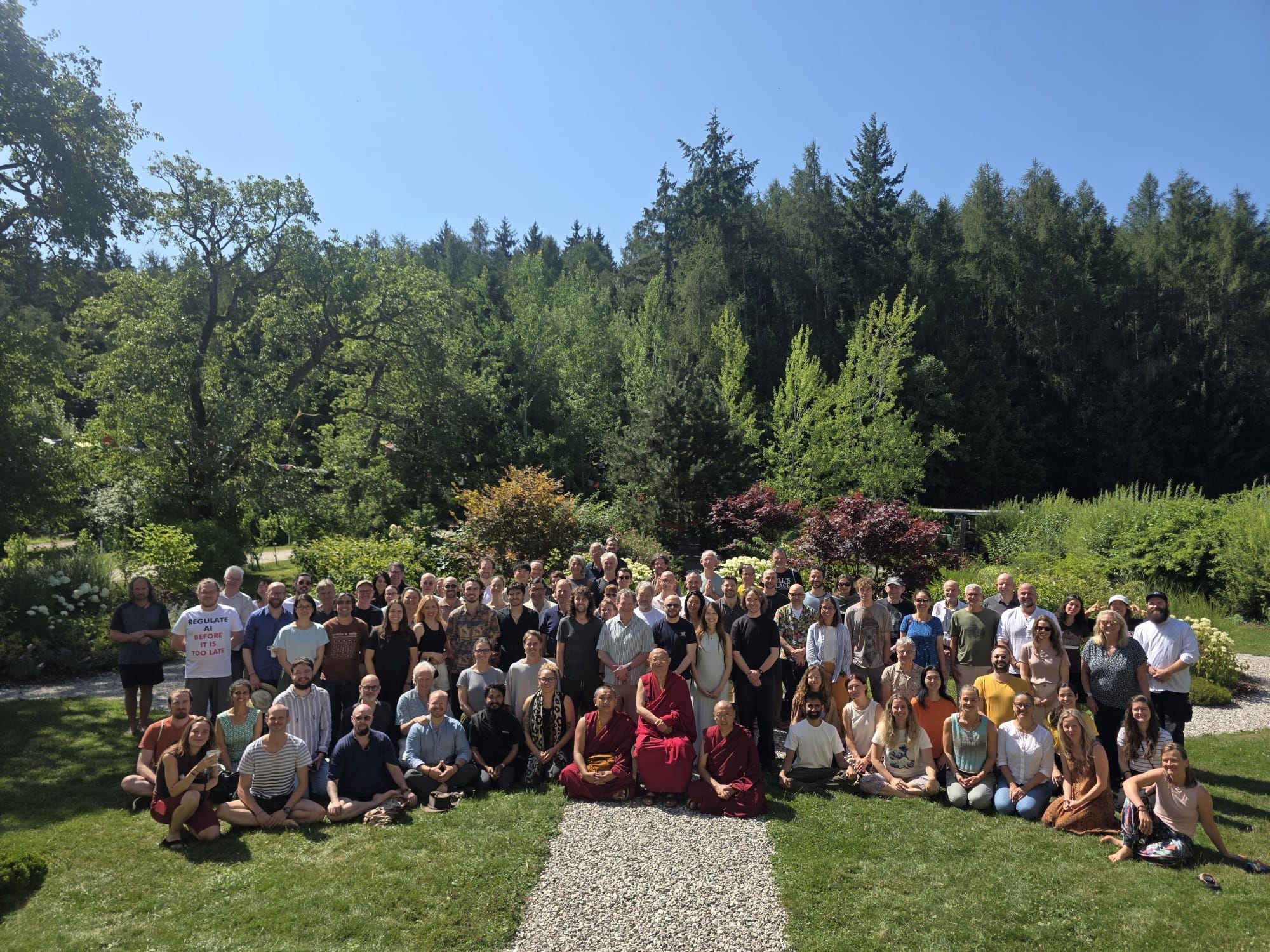
Photo by Birgit Meiche

Interesting crossover topic. I usually go to the Zendo to get away from AI. This is an interesting take on the topic
Do Robots Dream of Electric Buddhas? I wonder.
Thank you for this beautiful reminder to stay grounded as AI evolves.